Cornell Data Journal

The Fast
Fashion Cycle

Project Lead: Mei Knight
Analysts (alphabetical order): Emily Fang, Chris Jeong, Chloe Kritas, Maylani Lee, Jason Wang, Eric Zhu
Graphics: Chloe Kritas

Let's say you have $100 to spend on cute shirts.
What deal would you take?

1 shirt for
$100

2 shirts for
$50 each

4 shirts for
$25 each

10 shirts for
$10 each

If you picked #3 or #4, then this article is for you.

Yes, even #3 is bad.

Think about the clothes in your closest.

Think about that cute top you bought online for fifteen bucks, that pair of sweats that cost you less than a cup of coffee and a slice of pizza, that cheap dress you saw on social media that you no longer wear.

Let's say you have none of these things.

In the United States, that would make you one of the 13% of people who deliberately avoid fast fashion.1

I'm betting you aren't.

(I have an 87% chance at being right, after all).

[1] https://www.statista.com/chart/34362/share-of-respondents-who-avoid-buying-fast-fashion/

What is fast fashion?

It might be easier to start off with what isn't.

Luxury brands like Louis Vuitton, Chanel, and Saint Laurent are not fast fashion.

Neither are eco-friendly brands like Pact, Quince, and Patagonia.

Your local small business is a safe bet.

Slow fashion = ethically-sourced + mid-to-high prices + slow for new releases

(If you want to read more about luxury brands, check out my friend Kayla's article)
Everything else is pretty much fast fashion.

There's two levels:

(They fall under the pricing categories of #3 and #4, respectively, from before.)

Mass-Market Fast Fashion: Zara, H&M, GAP, and American Eagle. Think shopping malls with popular online stores as well.

Ultra-Fast Fashion: Mostly online stores like Shein, Temu, and Boohoo.

Our focus will be on "mass-market fast fashion," along with Shein. Wording for reports published by ultra-fast fashion companies are often unavaliable or extremely vague. Further research can be done on the exact differences between these categories.

Fast fashion is more than trendy clothes: it's where cheap labor meets lasting environmental consequences. But what exactly makes it so bad? And who is at fault?

We will break down this complicated cycle of fast fashion into three parts: companies, consumers, and consequences.

Companies

  1. State of the Industry
  2. Facilities
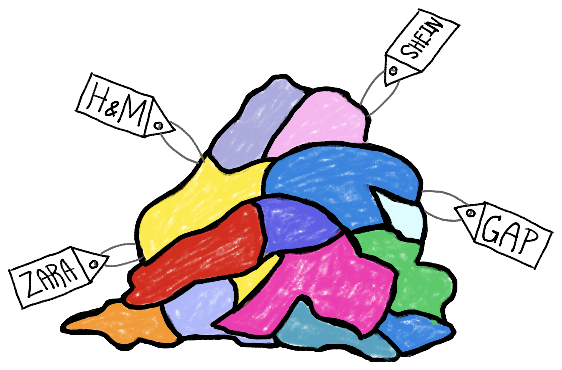
Illustration of a pile of clothing with brand tags for H&M, Shein, Zara, and Gap

State of the Industry

Fast fashion is one of the largest industries in the world. In 2022, it was valued at a whopping $106.42 billion and is expected to grow to $184.96 billion by 2027.1

We begin our investigation into fast-fashion companies with a crucial analysis of finance: their annual revenue.

We'll specifically look at H&M, Zara, Shein, and Gap.

By looking at these companies' annual reports, we can see that most of them have experienced fairly consistent revenue over the past ten years. This is despite each of them undergoing many changes to their operations and business models.

Annual Revenue of Fast-Fashion Companies

Looking only at this chart, the king of the fast fashion industry seems to be Inditex – the parent company behind Zara, Pull&Bear, and more. H&M follows closely behind, with Gap not quite making as much money as either retailer. Regardless, the key observation in this graph is their continued consistency in their year-over-year annual revenue. This makes sense. Each of these companies has been around for a long time, becoming established players in the fashion industry and household names. H&M was founded in 1945, followed by Gap in 1969, and Zara in 1975.

Stores operated worldwide by the end of 2015:

H&MZaraGap
3,9242,1623,721

One retailer, however, stands out from the rest.

Shein literally came out of nowhere. No one had even heard of them at this point (and if you did, you're lying). Originally founded in 2008 under the name ZZKKO (and later SheInside), Shein is by far the youngest of our four major retailers. By the end of 2015, Shein as we know it today didn't even exist. They were in the midst of a major internal transition, and they hadn't even operated under the name 'Shein' for a full year yet.

Nevertheless, they exploded onto the fashion scene in 2020 during the COVID-19 pandemic, quickly establishing themselves as the most disruptive fast-fashion retailer of the modern day. By 2022, their annual revenues had even surpassed that of Zara, demonstrating their ability not just to slay on the runway, but to slay all their competitors as well.

There is no understanding of fast-fashion without an analysis of Shein. When it comes to revenue, the story of fast-fashion is the story of Shein.

Unlike its competitors, Shein does not operate any stores. Its core business model consists entirely of direct-to-consumer shipping, which saves big in the many fixed costs associated with brick-and-mortar stores.

Annual Revenue of Fast-Fashion Companies

Stores operated worldwide by the end of 2025:

H&MZaraGapShein
4,1011,5003,5000

But that alone does not explain why they are so popular. For that, we must look more closely at their pricing (we'll touch on this later). The important thing to note is that in 2016, Shein had $0.6 billion in annual revenue. By 2025, that number now sits at $83.48 billion.

If there is one thing that the story of Shein taught us, it is that you really can't predict the future. But that hasn't stopped people from trying anyway. Some reports even show the fast-fashion industry reaching $387.7 billion by 2034.2 If the past few years are anything to go by, this industry shows no signs of slowing down.

For better or for worse, fast-fashion as a business is growing fast.

[1] https://www.statista.com/chart/34362/share-of-respondents-who-avoid-buying-fast-fashion/

[2] https://www.gminsights.com/industry-analysis/fast-fashion-market

Facilities

When you check the tag on your newest shirt, where does it say it's from? Perhaps it's locally sourced, or from far away in the Eastern Hemisphere. As the cycle of fast fashion continues to go round and round, one might wonder where most clothing produced for fast fashion companies comes from.

Because fast-fashion companies are known for their sweat-shop conditions and environmentally averse byproducts, many companies do not claim specific factories as their own. However, after parsing through factory location data using filtering toggles specific to fashion we were able to get a sense that the most significant producers of fast fashion have footprints in China, India, Spain, Bangladesh, and Turkey, respectively.1

Top 10 Countries by Scale
country_nametotal_facilitiestotal_workersavg_facility_size
China 992 139,740 141
India 317 63,053 199
Spain 196 2,027 10
Bangladesh 177 282,765 1,598
Türkiye 120 13,642 114
Hong Kong 73 687 9
Portugal 73 3,052 42
United Kingdom 46 2,445 53
Pakistan 39 30,739 788
Italy 37 3,197 86

To no one's surprise, China far outpaces the rest of the countries on this list, giving the familiar "Made in China" label more ethos. India isn't far behind, and boasts a large amount of total workers compared to the total number of facilities (according to data released to the public, of course). Notably, a strong majority of the top fast fashion companies have a presence in Asia. Shein, Zara, and H&M have vast manufacturing networks overseas, with Zara using as many as 3,800 supplier factories in Asia. And as such, the labor force driving the production of these materials comes from workers in the East.2

Due to the strong demand for new clothes that arrive quickly and cost little, fast fashion continues to propagate. As shown, most factories inputted on this site are still open, indicated by the overwhelming amount of green. Believe it or not, there are only three tiny orange dots located on the map representing closures. Knowing this, we can call on the demand of fast fashion and the cyclical nature of the clothes we wear everyday contributing to the propagation of these factories.

To add insult to injury, the constant demand for fast fashion and quick clothing has adverse effects not only on the people of (predominately) Asian countries, but reflects another global trend of emissions and climate change. As shown, a map of factory locations and emissions of greenhouse gases using data from the World Bank's data center reflects the correlation between countries with large presence in the fast fashion industry and GHG emissions.3

Though places such as China already have a large industrial footprint and these emissions cannot be solely attributed to the fashion industry, one can only wonder how much impact that quick Shein purchase or the two-day turnaround on an H&M sweater put out into the world.

While we have concluded that the U.S. doesn't have a strong factory presence, we still have to consider how much of the clothing that is made at these offshore places is from U.S. demand. Maybe when you look into your closet or make your next Shein purchase, you'll want to check the tags to see just where your clothing is coming from.

[1] As such, the data can be skewed in that not all factories are reported. Or, even if the factory is reported, how many workers really are there? We are using data from a public database, Open Supply Hub, to get a sense of the numbers in this industry.

[2] https://www.bbc.com/news/articles/cdrylgvr77jo

[3] https://data360.worldbank.org/en/indicator/WB_CSC_EN_ATM_GHGT_GT_CE

Consumers

  1. The "Average" Consumer
  2. Price is Right?
Illustration of a hand holding shopping bags

The "Average" Consumer

According to the 2024 Shein Fashion Report,1 this is what the "average" consumer looks like.
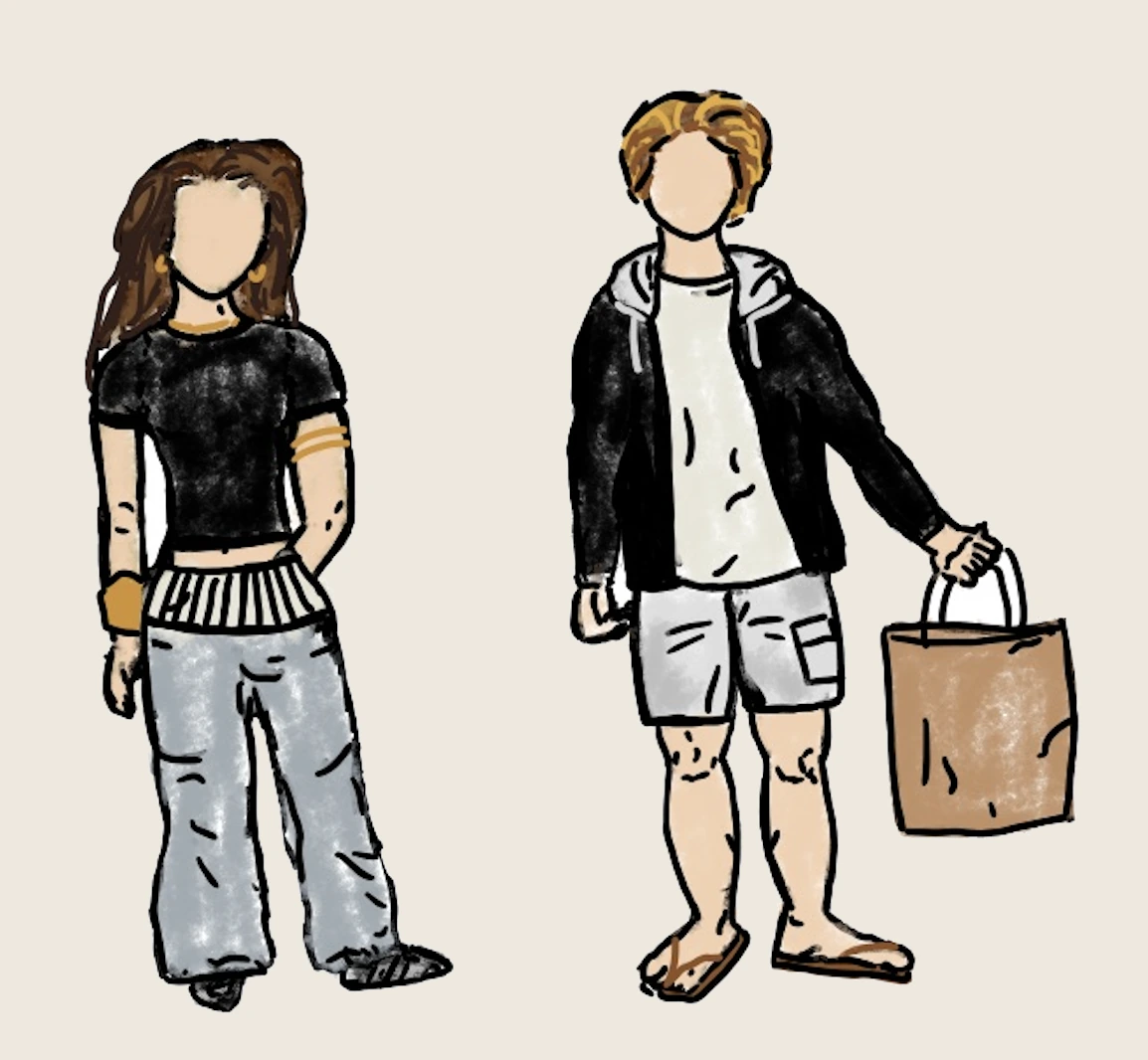
Two fashion figures with clickable dots for clothing details

Gen Z and Millennials are the biggest spenders. Why is this?2

Simple: young adults are more likely to be influenced by social media trends, and overconsumption is often promoted on Instagram and Tiktok. They're also known to be more impulsive and less aware of long-term consequences.

One of the most important parts of the fast fashion cycle are the consumers who buy the clothes these companies make. We sampled 112 Cornell University students to see if we could spot any trends regarding their spending habits. To ensure a diverse sample population, we sampled students from 4 grade levels, multiple genders, over 30 majors, and nearly 20 states. Since our sample population consists of only Cornellians, we cannot guarantee that there is no bias whatsoever.

In the past 3 months, how many clothing items have you purchased?

112 responses

Nearly half of the respondents reported buying 2-5 clothes every three months, with 26.8% of respondents reporting that they bought more than 5 items. Males were overall more likely to buy fewer clothes than females, with the largest gender gap falling in the 5-10 range. Both genders were almost equal when it came to buying 10+ clothes, with only a 3% difference.

What typically causes you to purchase an item of clothing?

112 responses

Cornell students are less affected by trends and more affected by sales and specific purchases for an event. Sales and specific purchases tied for most popular, with 63.4% of respondents listing them as two of their top reasons for consumption.

On a scale of 1-10, how important is price/sales when deciding when and where to shop?

112 responses

We can also see that most respondents rated sales at 8 on a scale of 1-10 when describing how important cheap prices are for deciding where to shop. These factors are the major draws of fast fashion. Cheap clothes are the largest selling point for companies like Shein, which uses a low-cost business model to make its profits. Throwaway clothes for specific events are also a major profit generator. Many fast fashion brands have added categories to their websites specifically made for this category of consumption. For instance, Boohoo, a successful fast fashion brand based in the UK, has a page dedicated to "Festival Outfits" that are meant to only be worn once and then thrown out.

(If you want to read more about music festivals, check out my friend Vivian's article)

What percentage of your closet do you think comes from fast fashion brands?

112 responses

We found an interesting discrepancy in our data when our respondents were asked to consider what percentage of their closet came from fast fashion. Despite listing cheap prices as one of the most important factors when it comes to buying clothes, 42% of our respondents claim that their closets are made up of less than 25% of clothes from fast fashion brands, while 58% claim that their closets have more than 25% percent. While there could be many reasons why this is the case, one issue may be the definition of fast fashion itself. We never defined what fast fashion was, apart from listing H&M, Zara, and Shein as examples. These companies are defined under "ultra-fast fashion," while companies like American Eagle, Anthropologie, and Garage are also seen as fast fashion, just without the "ultra" designation.

When you no longer wear an item, what do you do with it?

112 responses

Cornell is better than the global average in clothing waste! In 2025, the U.S. Environmental Protection Agency (EPA) reported that 62.5% of clothes were thrown in landfills every year. It appears that Cornell students are more mindful about waste, with 55.4% of respondents saying that they mostly donate their clothes and only 3.6% saying that they throw their clothes away.3

On a scale from 1-10 how harmful do you think your clothing purchases are on the planet?

112 responses

We can see a normal distribution form in our scale of 1-10 when asking how harmful a respondent believes their purchases are. While most respondents clustered in the middle, the most chosen answer was at a scale of 3 with 20.5% of respondents choosing this option. This shows that most people underestimate their influence on the environment, believing that they are either on average or lower than others when it comes to negative environmental impact.

[1] Report was taken down recently

[2] https://www.sciencedirect.com/science/article/pii/S0959652624024193

[3] https://greenamerica.org/unraveling-fashion-industry/what-really-happens-unwanted-clothes

Price is Right?

As illustrated by our survey responses, one of the largest appeals of fast fashion to consumers are its low prices. To get an idea of how cheap these brands are, we sampled around 200 items from the websites of four major fast fashion brands (Zara, Gap, H&M, Shein) across four general categories (Tops, Dressses, Pants & Jeans, Coats & Jackets).
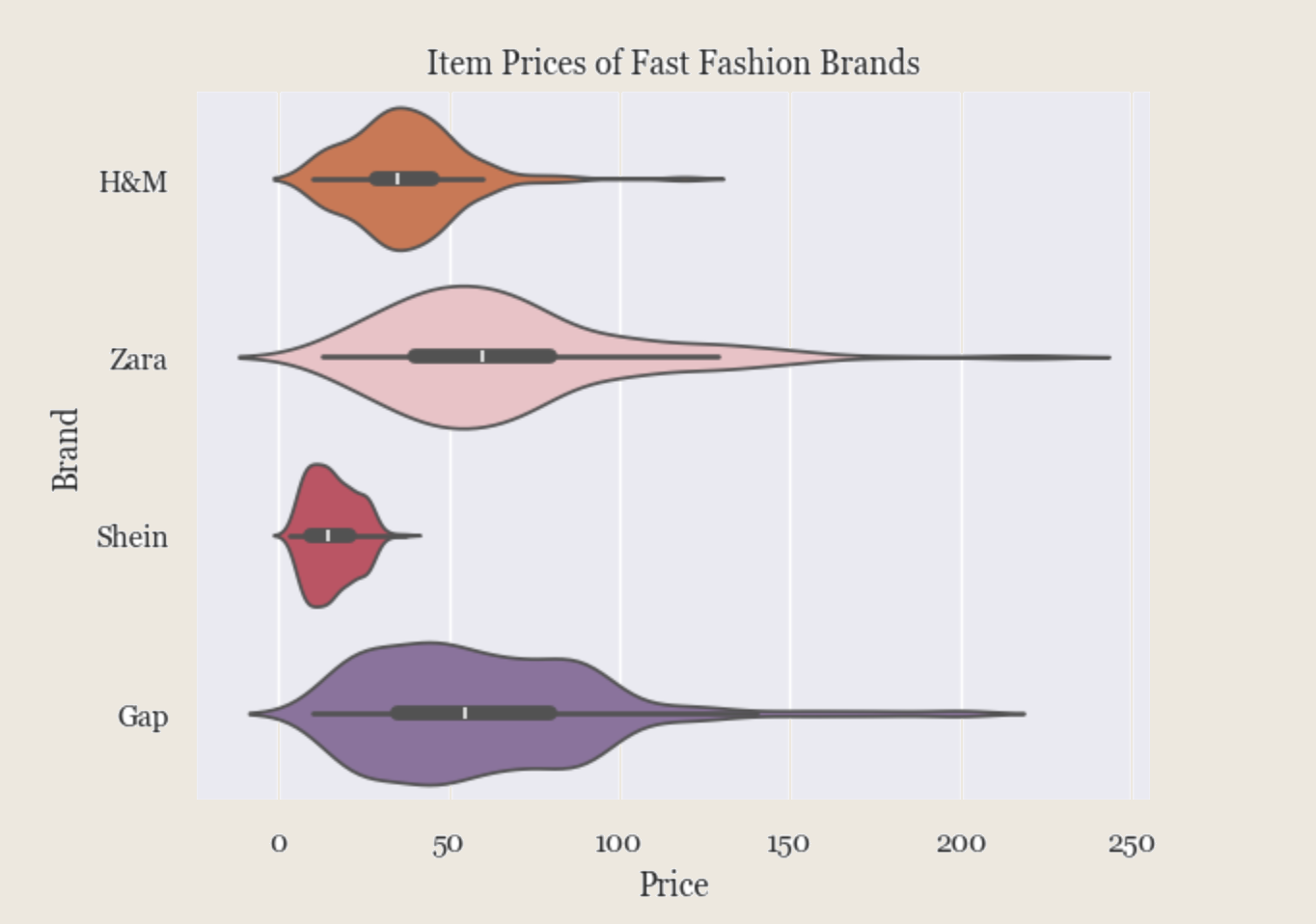
Static violin plot showing item prices of fast fashion brands H&M, Zara, Shein, and Gap

Of all item categories, tops are by far the cheapest across all brands. They are most representative of the fast fashion business model—low cost, high output, chasing trends. More expensive items such as coats and dresses typically have a longer lifespan.

Fast Fashion Brand Mean Prices by Category

These four companies represent a spectrum of pricing strategies. Zara and Gap have the highest average prices with certain items reaching above $200. This reflects Zara's shift to a more luxury image, introducing collaborations with fashion designers such as John Galliano and Willy Chavaria with items in these collections priced in the hundreds of dollars. H&M lives in the mid-range, focusing on affordable basics with occasional ventures into higher-end collections. Shein is by far the cheapest, with its entire catalog pricing in below the mean prices of Zara and Gap. In fact, a staggering 26.5% of Shein's offerings come in at below $10. The next highest company in this metric, H&M, barely scratches past 1%.

Shein is evidently in a league of its own when it comes to affordability, but this comes at the cost of its quality and labor practices, as we will see later on. Ultimately, while the consumer may not pay as much, somebody else—namely the workers and the environment—pays the price for it.

Consequences

  1. Case Study: H&M's Impact on the Environment
  2. Overall Carbon Emission Trends
  3. Other Valuable Metrics
Illustration of an overflowing clothing bin

H&M's Impact on the Environment

H&M is one fast fashion company that, unlike many brands, makes an effort to be somewhat transparent about their environmental footprint. We specifically explored their carbon emissions as reported in their 2024 Sustainability Report.
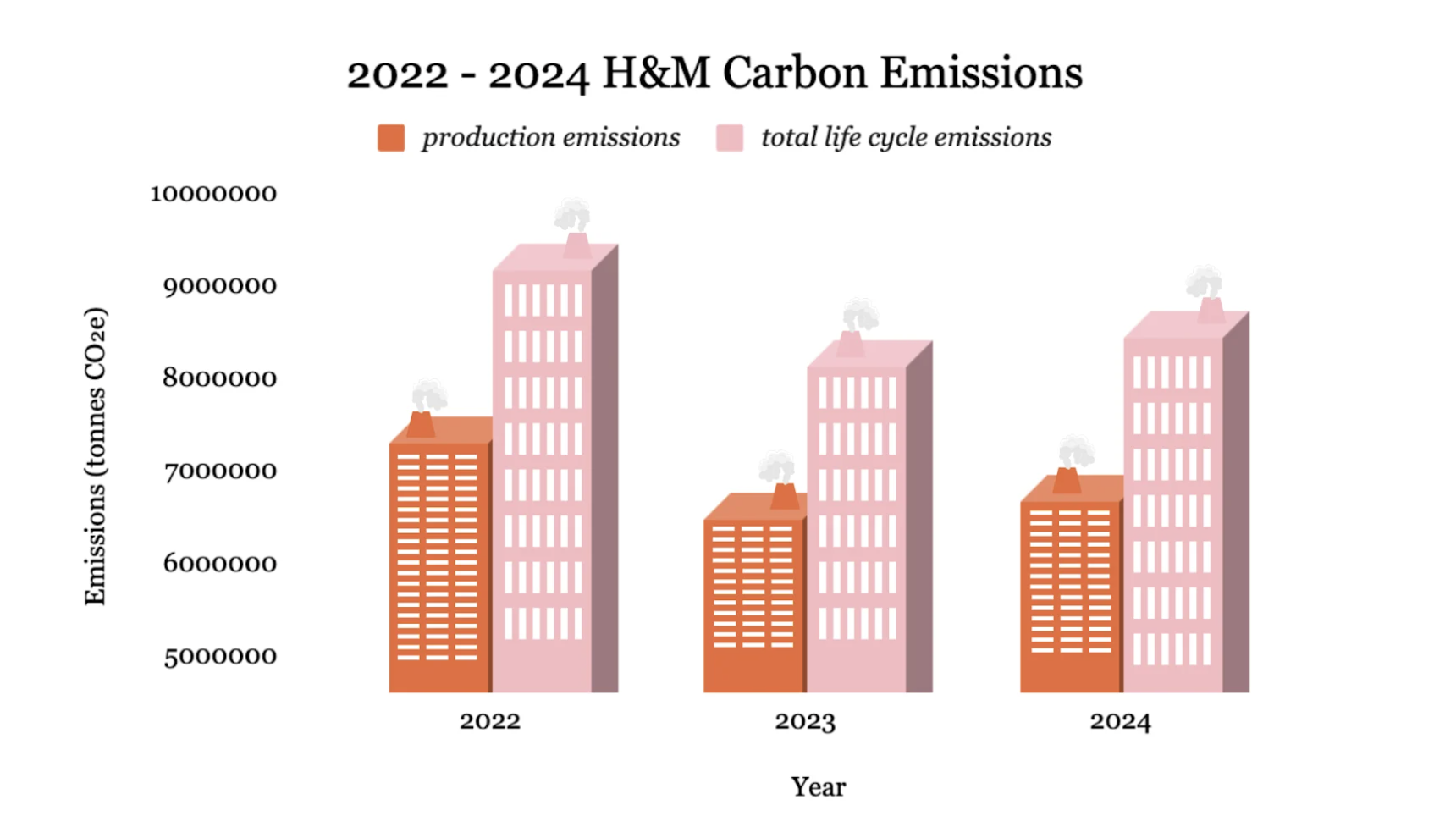
Static graph titled 2022 - 2024 H&M Carbon Emissions showing production emissions and total life cycle emissions

The graph above shows that overall carbon emissions from both the production and post-production (including the impact made after the article leaves the production line) decreased from 2022 to 2024. However, both began to rise again after taking a dip in 2023.

As shown in the charts above, the three largest contributors to emissions over the three years were fabric production, raw materials, and use of sold products, representative of activities outside of the company's direct operational footprint. However, emissions from these activities barely decreased compared to total emissions. In fact, the proportion of emissions as a result of these top three was 0.778 in both 2022 and 2023 and actually increased to 0.782 in 2024, indicating that H&M was not tackling its largest problem. Decreasing emissions from operations likely wouldn't have the significant impact needed to meaningfully reduce total emissions, since operational activities only have a small impact on overall carbon emissions.

The data suggests that H&M is making changes in the stages of their clothing production that they can directly control, such as business operations and energy usage, but not addressing the stages that are more carbon-intensive, which would make the most meaningful difference for their environmental footprint.

Overall Carbon Emission Trends

Not every clothing company is as transparent as H&M, however. Finding year-to-year data for greenhouse gas emissions for other companies proved to be difficult, as the sustainability reports provided only a couple of years of data. On top of that, the exact causes or types of emissions are not specified.

Nonetheless, using the data that has been provided in Gap and Zara's sustainability reports, there is a clear culprit for the environmental impact being left by these fast fashion companies: manufacturing and production. As seen in the graph below, around 99% of all emissions are coming from Scope 3, which encompasses the upstream and downstream activities of these companies that include purchased goods and services and product use. Scope 1 and 2 emissions encompass all emissions caused by direct and indirect emissions from running the clothing stores and factories, including electricity and the use of company vehicles.

These companies generate around 10 million metric tons of emissions annually. Less than 1% of these emissions come from their direct operations and 99% originate from their value chain. These companies aim to reduce their emissions by targeting their Scope 1 and 2 emissions, which they have successfully done, as shown in the graph below. However, it is clear that emissions are embedded in the constant production of clothing, not in how they run their stores. Addressing this issue requires shifting the focus from operational efficiency to transforming production systems.

Other Valuable Metrics

Another useful metric to look at is the estimated production intensity of fast fashion companies. The higher the production intensity, the more carbon emissions. The same downward trend in carbon emissions can also be seen here. From 2021 to 2024, production intensity has decreased for Gap, H&M, Shein, and Zara, decreasing especially dramatically for Shein.

Don't be tricked! A lower production intensity does not necessarily mean better environmental outcomes. Fast fashion companies are finding ways to lower their carbon emissions during the manufacturing stage while increasing their overall revenues. By becoming more efficient, these companies are able to produce more clothes to sell. More clothes equals more landfill waste. In fact, in 2025, the United Nations reported that "a garbage truckload of clothes is dumped or burned every second" (Mishra 2025)1.

Landfill waste is the final stage of carbon emissions. The material composition of the clothes produced by H&M, Shein, and Zara give us an insight to what types of materials are found in our landfills.

Material Composition by Company
H&M
Shein
Zara

The most common material is cotton followed by polyester. While cotton is of higher quality and can decompose rather easily, it only decomposes this fast when the product is 100% cotton, a rarity in the fast fashion industry. Meanwhile, some research shows that "polyester, nylon and acrylic, can take up to 200 years to decompose" (Nicolaus 2025)2. Considering that Shein mostly uses polyester in their clothes, it's safe to say that waste from Shein could be hanging around our landfills for longer than the life span of two humans back-to-back. Increased efficiency with these fast fashion companies paired with increased consumption has created a formula that ensures environmental catastrophe in our near-future.

[1] https://news.un.org/en/story/2025/03/1161636#:~:text=Fast%20fashion%20is%20accelerating%20an,speed%20and%20disposability%20over%20sustainability

[2] https://www.thenationshealth.org/content/55/3/1.1

Essentially, this is our present.

Now What?

Illustration of a light bulb with a plant growing inside

In the words of Billy Joel: "We didn't start the fire. It was always burning since the world's been turning. We didn't start the fire. No, we didn't light it, but we tried to fight it."

While the cycle may feel overwhelming especially as a consumer, you actually have a lot of power to make small changes in your everyday life.

Real change does not require you to be perfect, but it starts with making conscious decisions about where you are shopping.